
Biowastes: Supporting the Circular Economy and Green Gas Production
From the Trash Can to the Grid: How Biowastes Become Green Gas.
From the Trash Can to the Grid: How Biowastes Become Green Gas.
Effective January 1, 2024, in compliance with the Anti-Waste Law for a Circular Economy, the sorting of biowastes has been extended to both businesses and households.
The biowaste sector must achieve economic viability in order to grow and encourage the implementation of sorting and collection. Anaerobic Digestion is one of the main methods of waste recovery. It generates two byproducts: Biomethane, a renewable energy source that, once injected into gas networks, contributes to making energy uses such as heating and transportation more sustainable; and Digestate, a natural fertilizer that makes Anaerobic Digestion complementary to Composting solutions.
With a potential of more than 5.5 million metric tons of biowastes available annually in France, the development of this new sector presents significant opportunities in terms of local job creation, production of renewable energy, and sustainable agriculture. By 2030, biowastes will represent a harnessable energy potential that could reach up to 9 TWh/year of Biomethane.
What is biowaste?
Non-hazardous, biodegradable waste from gardens or parks; food or kitchen waste from households, offices, restaurants, wholesale businesses, cafeterias, catering services, or retail stores, as well as comparable waste from food processing plants (Article L. 541-1-1 of the Environmental Code)
Anaerobic Digestion of Biowastes: A Virtuous Cycle for Local Communities
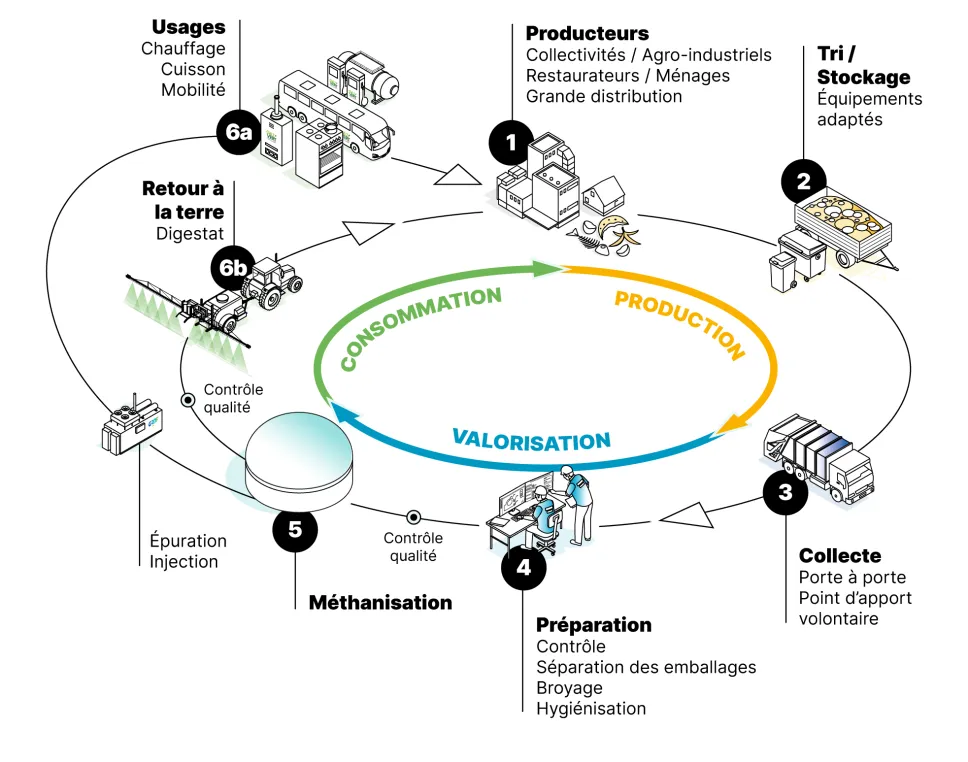
Credits: Emmanuel Letoupin
Key Figures
Nearly 50% of French people have access to a biowaste sorting solution implemented by their local government (60%: individual or shared composters, 40%: access to door-to-door biowaste collection or public drop-off stations).
900,000 metric tons of sorted biowastes per year (which avoided incineration or excavation)
1,000 metric tons of biowastes produced by approximately 9,300 households, based on 83 kg per capita per year collected, is equivalent to
- 1.1 GWh of Green Gas (1 metric ton of biowastes produces 100 Nm³ of Biomethane with an HCV of 10.8 kWh/Nm³)
- 4 buses running on BioNGV 1 bus consumes ~254 MWh/year
- 275 households supplied with Green Gas 1 new home consumes ~4 MWh/year
Annual Breakdown of Household Waste
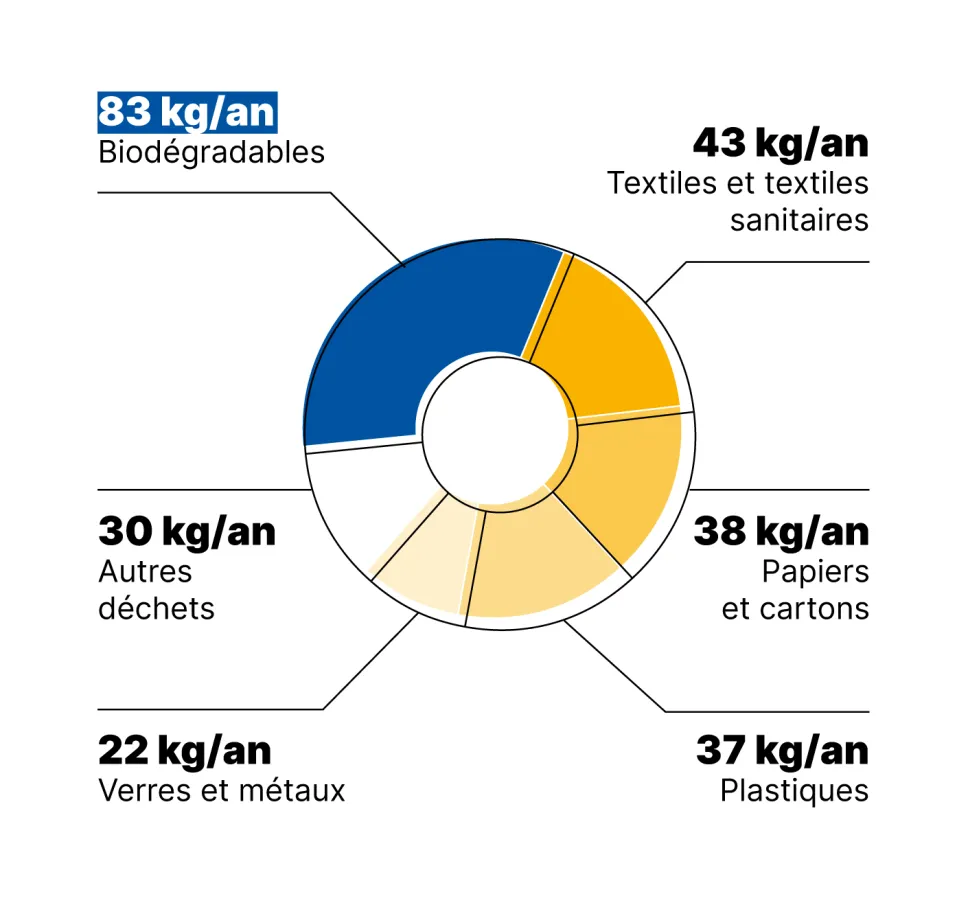
Credits: Emmanuel Letoupin
GRDF supports and conducts Awareness Raising in local communities
GRDF supports local governments in managing biowastes and recovering energy from them:
- by informing them of the available resources for mobilization and the benefits for each region;
- by assisting them in implementing source separation, through co-funding studies via calls for innovative projects or by providing support for project development;
- by conducting awareness raising among stakeholders about the specific characteristics of biowastes anaerobic digestion.
The different steps for recycling biowastes through Anaerobic Digestion
- In order to be processed at one or more Anaerobic Digestion facilities in the region, biowastes must be collected through door-to-door pickup or at drop-off stations.
- If it is improperly sorted or packaged—as is the case with residual biowastes from supermarkets, for example—it must be unpackaged. This involves separating the organic content from the container and removing all non-biodegradable plastic or metal residues.
- For food-based biowastes, a sanitization step is required before recycling: this eliminates all pathogenic germs by heating the waste to 70°C for 1 hour, similar to pasteurization.
- After these steps, the biowastes can then be recycled through Anaerobic Digestion: the biowastes are fed into a digester where they are mixed and heated to approximately 38°C. As fermentation occurs, bacteria break down the waste, converting it into digestate—which can be used as a natural fertilizer—and biogas. Once purified, the biogas becomes Biomethane. Before being injected into the network operated by GRDF, it is odorized and its quality is checked.