
Biomethane: A Strategic Energy Source for a Low-Carbon France
Renewable, locally produced, and low-carbon, it offers many benefits
Easy to store, Biomethane can help achieve decarbonization in the French economy and strengthen the country’s Energy Sovereignty.
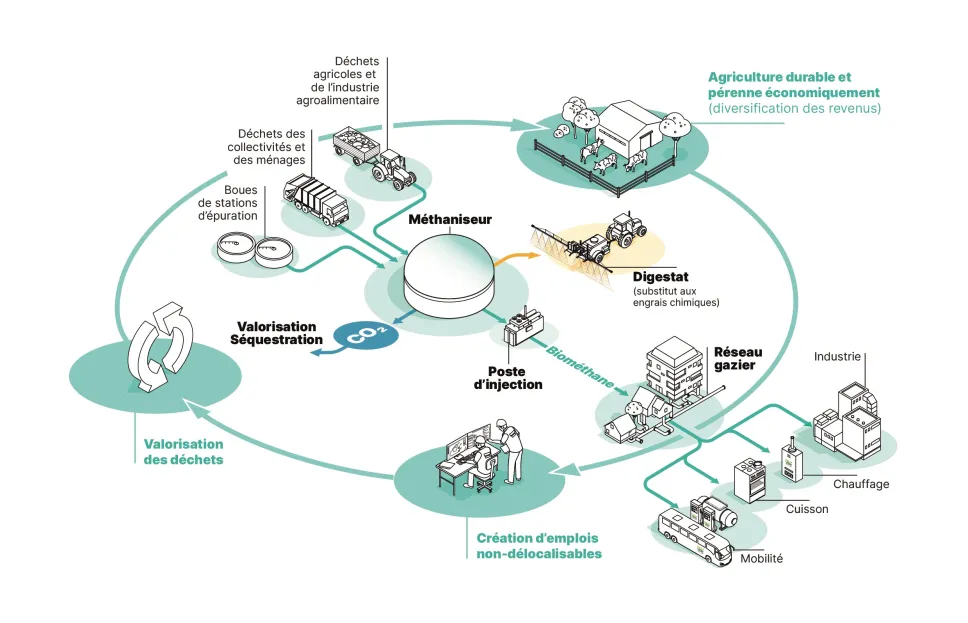
Recycling waste, supporting agriculture, creating local jobs, and producing renewable energy: Green Gas checks all the boxes for a sustainable energy model. Produced in France, storable, and low-carbon, it helps secure our energy supply while creating value in local communities.
How is it produced?
Biogas is a renewable energy source produced locally from Agricultural Residues, energy crops (CIVE), Livestock Effluents, and regional waste. After purification, biogas becomes biomethane, which is just as efficient as Natural Gas.
Energy Independence, job creation, production of natural fertilizer… producing Renewable Gas is about more than just generating energy!
Credits: Emmanuel Letoupin
The injection capacity registry lists nearly 1,357 additional projects, representing a potential of 23.4 TWh/year, which is more than current production.
851
Biomethane Injection sites,
including 1 Power-to-Gas site as of August 31, 2026, and 721 sites on the network operated by GRDF.
soit 16,43
TWh/year
Generation capacity equivalent to that of approximately 3 nuclear reactors, 4.1 million new homes heated with natural gas, or 65,720 buses running on BioNGV.
41,6
g CO2 eq/kWh (based on ADEME data)
The Carbon Assessment, analyzed on a life-cycle basis, nearly 6 times lower than that of Natural Gas.
Plus de 3
millions of metric tons of CO2 avoided in 2025, the equivalent of 1.6 million round-trip flights between Paris and New York.*
A Booming Industry
- 2013 : Connection of the first agricultural anaerobic digestion facility for grid injection
- 2030 : A target of 44 TWh/year of Biomethane included in the multi-year energy policy
- 2050 : France could meet 100% of its gas demand with Green Gases
An increasingly sustainable sector
- 90% of the feedstock for Anaerobic Digestion is sourced from the agricultural sector. France has set a limit of 15% for the proportion of primary crops dedicated to energy production in the feedstock mix for Anaerobic Digesters. In practice, this share is estimated at around 5.5% according to France AgriMer.
- The European Renewables Directive (RED) imposes strict and monitored criteria for greenhouse gas reduction and the origin of feedstocks.
Various financing mechanisms
A state-supported feed-in tariff introduced in 2011 to support the development of Anaerobic Digestion facilities and reassessed in 2023: ensures the producer a guaranteed selling price for 15 years.
Two extra-budgetary mechanisms
Biogas Purchase Agreement (BPA): a direct contract between the producer and the consumer that guarantees a volume, a price, and a term to encourage investment.
Biogas Production Certificates (CPB): a mechanism that took effect on January 1, 2026, requiring Gas Suppliers to meet a biogas production obligation, with the traceability of that production ensured through certificates.
Cogeneration – Feed-in: Tipping Point
A decree exempting producers from penalties if they cease cogeneration in favor of feed-in, among other measures, was signed in September 2025. With appropriate support, the industry estimates it could reach 4 to 5 TWh of conversion.
A managed transition at an acceptable cost
The Gas Network will play an essential role in Decarbonization. To support the growing production of Green Gases, the existing network will require relatively modest investments, ranging from 6 to 9.7 billion euros, by 2050.
Green Gas has a vital role to play in achieving a balanced, decarbonized, and socially acceptable Energy Mix.
As the Distribution System Operator, GRDF assists project developers with the preliminary steps, performs the Connection, and then ensures the Biomethane Injection into the gas network (Odorization, quality control, pressure regulation, Metering).
The press release is available here:
* Calculation based on the difference between the Carbon Footprints of Natural Gas and Biomethane, multiplied by production capacity.