
Decarbonization of the building sector by strengthening the role of natural gas
Why is the temptation to move away from natural gas a miscalculation?

Between the production of the necessary materials, construction, operation, and end-of-life management of a building, the sector’s share of the national Carbon Footprint was estimated in 2019 at approximately 25%, 67% of which was attributable to the operation phase (ADEME BâtiZoom 2019 figures).
While the climate emergency demands that we accelerate the Energy Transition, the massive shift toward electric solutions or district heating networks sometimes seems like the logical path to reducing the building sector’s carbon impact. However, reality calls for a more nuanced approach in which natural gas has a vital role to play, to avoid technical, economic, and social pitfalls that could jeopardize the achievement of these goals.
Surprising? Paradoxical? Not at all.
Because gas is no longer just a fossil fuel. Because it is becoming green, renewable, and low-carbon. Because it remains efficient and compatible with all current uses.
Over the years, natural gas has gradually established itself as the go-to energy source for heat generation in buildings.
Why has it been so successful, and what role does it play today?

Credits: Getty Images
In the 19th century, Natural Gas was not yet being extracted, and what was then called “town gas” had to be manufactured. Produced from wood and coal coke, it was initially used for street lighting before finding its way into homes around the turn of the 20th century. Cooking, hot water, and heating—its uses diversified at a time when heating needs still depended mainly on solid fuels (coal and wood).
The spread of gas into homes gained momentum during the first half of the 20th century, driven by a desire for progress, falling costs, and a network that could now supply gas to customers farther from production sites.
By 1930, 130,000 kilometers of gas pipes were already delivering town gas to more than 5 million subscribers (source: Coénove – Decarbonization of Buildings, the Key Role of Green Gases).
The discovery of the first Natural Gas fields in France (1939 and 1960) and the Netherlands (1967), combined with the development of import and transportation infrastructure, marked the end of town gas but solidified gas’s role in the building sector, including in district heating systems.
Less restrictive and costly than coal and heating oil, it offered instant power and comfort to a population seeking modernity.
Today, natural gas is integrated into the operation of a wide diversity of buildings due to its calorific properties and cost-effectiveness.
In addition to supplying individual and multi-family homes with heating, hot water, and cooking, it is used in the commercial sector—particularly in offices, schools, and hospitals—as well as in sports facilities and public and cultural buildings. Not only does gas help maintain comfortable and easily adjustable conditions in these settings, but it can also regulate the temperature of a swimming pool or contribute to the preservation of works of art.
Hotels, restaurants, and certain food establishments also choose it for the precision it brings to professional cooking.
At 697 TWh, building operations alone accounted for 45% of France’s final energy consumption in 2024. The residential sector’s energy needs were twice those of the commercial sector, even though the ratio of floor space is 3 to 1.
In terms of direct emissions (Scope 1), the building sector accounted for 15.5% of national greenhouse gas (GHG) emissions, totaling 57.1 MtCO2eq: 35.5 MtCO2eq for the residential sector and 21.5 MtCO2eq for the commercial sector.
With 35% of the building sector’s energy consumption, fossil fuels are the focus of attention, and the role of Natural Gas is central to many of the challenges.
To better understand how to achieve decarbonization in the sector, it is important to recognize that every building is unique in terms of its location, use, and environment.
Therefore, there is no single solution for reducing its Carbon Footprint, but rather a range of solutions.

Credits: Getty Images
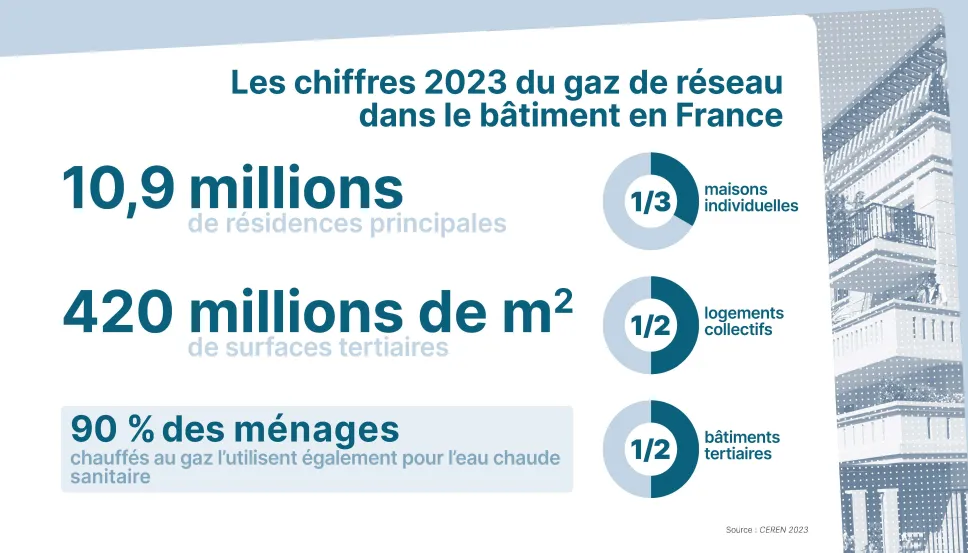
The Gas Distribution Network currently serves 9,600 municipalities in metropolitan France. By covering primarily densely populated areas, this network enables approximately 77% of the population to use gas as one of their energy sources for heating, cooking, or producing domestic hot water.
Credits: Patrick Guillon
Not all buildings supplied with gas are necessarily located in urban or suburban areas. Some are scattered across vast areas and have been connected to the Gas Distribution Network as opportunities arose and based on their region’s gas needs.
Conversely, more than 24,500 municipalities are not connected to the Gas Distribution Network. These are spread across rural areas, mountainous regions, and more isolated areas, where difficulties in access and/or low building density did not justify extending the distribution network.
Although residents in these areas cannot use natural gas from the grid, they still rely on storable fossil fuels such as heating oil, butane, or propane to meet their heating needs.
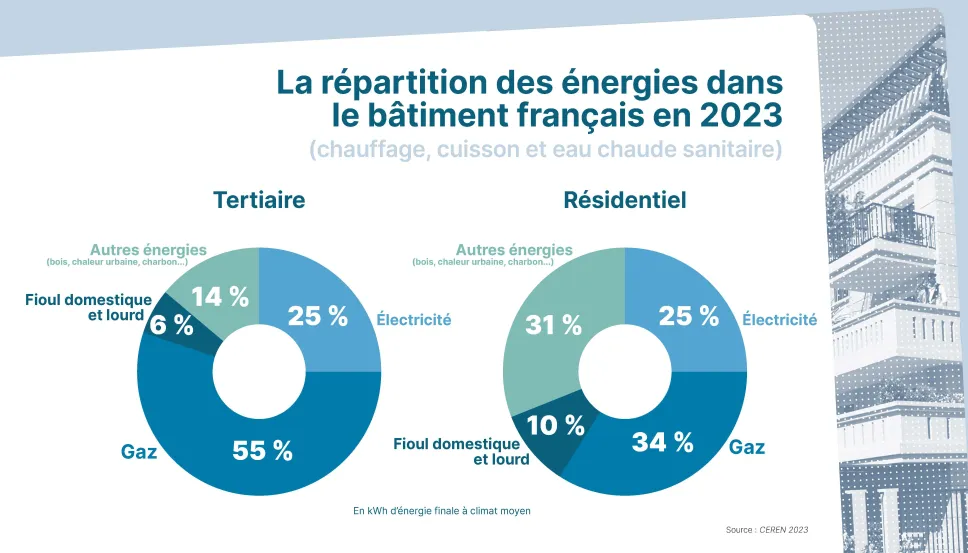
A multitude of factors can therefore influence the choice of a heating solution in a building. Thus, beyond the availability of energy sources, economic constraints, performance requirements, and changes in regulatory frameworks have shaped a varied and diverse landscape over the years.
Credits: Patrick Guillon
To support the Decarbonization of the building sector, Europe and France have, over the years, developed and adopted a number of legislative and regulatory measures and provisions.
While the goal is clear, the framework outlined to achieve it deserves closer examination.

Credits: Stéphane Saint-Hilaire
Compliance with the European roadmap “ Fit for 55 ” (see box) and the national commitment to Carbon Neutrality by 2050 require France to raise its ambitions for the building sector: reducing energy consumption, High-performance Energy Renovation, phasing out fossil fuels, and greening energy sources—the measures primarily concern building operations.
The draft documents for the future National Low-Carbon Strategy (SNBC3) and the new Multiyear Energy Plan (PPE3) explicitly raises the targets for 2030, prioritizing large-scale electrification and unconditional support for district heating networks.
The transformation of the building stock is based on a series of national and European regulations that govern New Construction, renovation, and energy consumption planning.
It governs all New Construction and marks a major shift toward more energy-efficient, low-carbon, and Climate Resilient residential and Commercial Buildings. In particular, it subjects new construction projects to progressively stricter thresholds designed to reduce their energy needs by 30% compared to the 2012 Thermal Regulations (RT2012) and to cut their Carbon Footprint by 40% by 2030. While increasingly strict thresholds encourage the use of materials with a lower environmental impact, they also contribute to the phase-out of fossil fuels in favor of electricity (regardless of its source), district heating networks, and renewables.
What does this mean for natural gas in buildings?
While the RE2020 does not ban gas in new buildings, it profoundly changes the conditions for its use with CO2 emission thresholds that are increasingly unfavorable to it. Further revisions are planned for 2028 and 2031. Aside from a few specific cases, gas boilers are already a thing of the past when used alone, whether for individual or communal heating.
Stemming from the ELAN Act, this regulatory requirement mandates a gradual and measurable reduction in the final energy consumption of Commercial Buildings larger than 1,000 m2, whether new or existing. The overall goal is to reduce consumption by 40% by 2030, 50% by 2040, and 60% by 2050, compared to 2010 levels. All commercial and service sector activities are covered, whether public or private, and all building uses are taken into account. To achieve lower and more efficient energy consumption, optimizing a Commercial Building’s Energy Performance also involves selecting the right heating, domestic hot water, and ventilation systems, as well as managing their operation.
What does this mean for natural gas in buildings?
Without explicitly targeting natural gas or referring to CO2 emissions, the Tertiary Sector Decree places significant pressure on heating-related energy consumption to meet the expected trajectory. With the exception of the latest-generation gas equipment, such as High Energy Performance Boilers (HEPB) or Hybrid Heat Pumps (HHP), older gas solutions are quickly at a disadvantage compared to electricity or district heating networks. For these two energy sources, the regulation does not account for the total energy consumption generated by buildings.
It provides a standardized assessment of the Energy Performance and climate performance of a home or building based on its annual primary energy consumption and CO2 emissions. By assigning a letter rating from A to G, it helps identify energy-inefficient buildings and prioritize Energy Renovation efforts across the housing stock. All underlying calculations are based on the concept of primary energy—that is, energy available in nature before any human transformation.
What impact does this have on gas use in buildings?
In France, Natural Gas has a conversion factor of 1. In other words, 1 kWh of gas, a form of primary energy, yields 1 kWh of LCV or final energy. In contrast, it takes an average of 2.5 kWh of electricity to provide 1 kWh of heat. This is because the production of electricity from other primary energy sources such as wind, gas, or nuclear power results in energy losses, as do transmission and distribution. However, as of January 1, the regulatory ratio was reduced to 1.9 by the government, effectively lifting the “energy-inefficient” status of hundreds of thousands of the lowest-rated homes. The advantages of gas for heating purposes are thus automatically diminished.
Administered by ADEME, it is the primary public funding mechanism designed to accelerate the development of renewable and waste heat (RE&R). It supports both production facilities (Biomass, geothermal, solar thermal, Anaerobic Digestion, Waste Heat) and the district heating networks that distribute the heat. The Heat Fund explicitly aims to replace carbon-based energy sources with local and renewable solutions to reach 38% renewable heat by 2030.[info.gouv.fr]
What does this mean for Natural Gas in the building sector?
The Heat Fund’s mandate is clear: to reduce dependence on fossil fuels and Natural Gas. By being granted the status of classified infrastructure, the district heating network is systematically prioritized whenever competition with the gas network is identified—whether the gas is Biomethane or not.
It aims for a zero-emission European building stock by 2050, meaning no on-site production of CO2. Guided by the principles of large-scale renovations, reduced primary energy consumption, and phasing out fossil fuels, it establishes a framework for New Construction with short-term deadlines: 2028 for public buildings and 2030 for all others. Member states are required to adapt their roadmaps accordingly.
What impact will this have on gas use in buildings?
This directive explicitly targets gas-based solutions by excluding any energy source that emits CO2 locally when used in a building. Gas boilers and HHPs powered entirely or partially by Natural Gas are becoming undesirable. While member states retain some flexibility in implementing the regulations, this European initiative even leaves uncertainty regarding the integration of Green Gas, despite its recognition as an energy source capable of powering “zero-emission” buildings.
Launched in 2022 in response to the war in Ukraine, this is the European plan to end dependence on (Russian) fossil fuels and accelerate the Energy Transition. It emphasizes energy conservation, diversification of supply, and increased production of renewables such as solar power, district heating, Biomass, and Green Gas. Of note is the target of 35 billion m³ of Biomethane by 2030 (~405 TWh HCV).
What impact will this have on gas use in buildings?
By encouraging member states to provide massive funding for building retrofits, Heat Pumps, Self-consumption, and district heating networks, the plan paves the way for a rapid decline in the role of fossil gas in the building sector. Despite support for the Biomethane Value Chain, it is far from certain that Green Gas will be used for heating.
Each year, RTE publishes its Forecast Report, which public authorities consider the benchmark study for supporting the national Decarbonization trajectory through the electrification of end-use sectors.
In the Buildings section of the 2023 edition, the selected scenario gives pride of place to electric Heat Pumps, with a target of 8 million units installed in residential buildings by 2030 and 11.5 million by 2035, while also anticipating a 45% reduction in the number of gas boilers (6.1 million in 2035 vs. 10.8 million today).
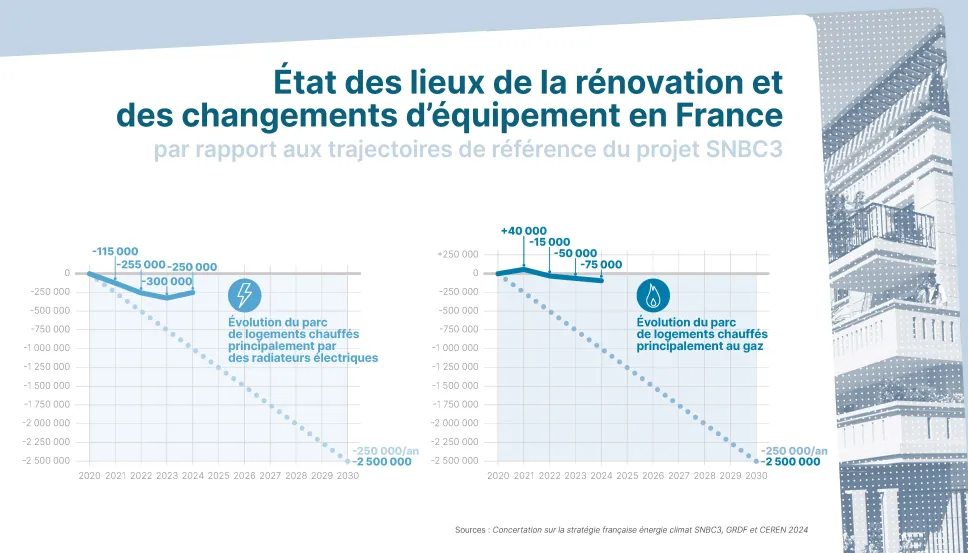
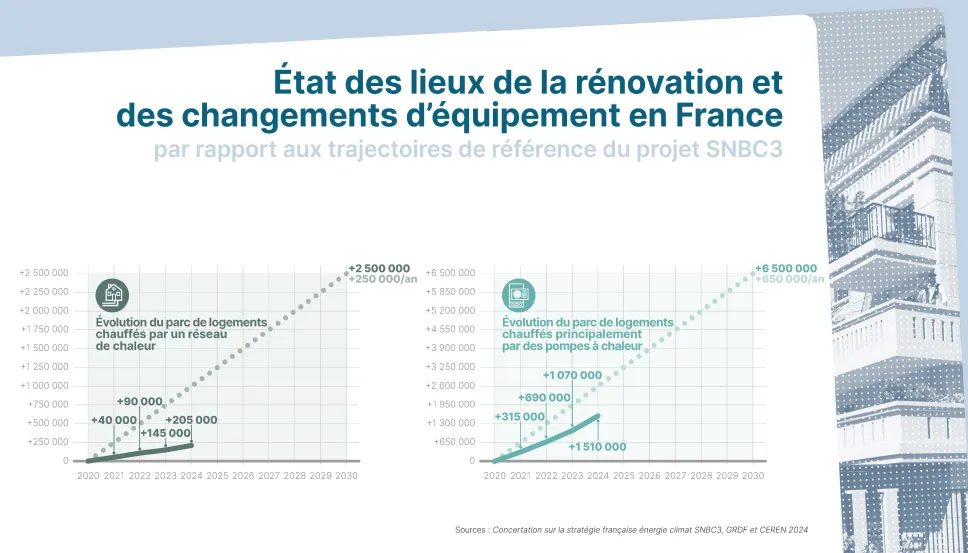
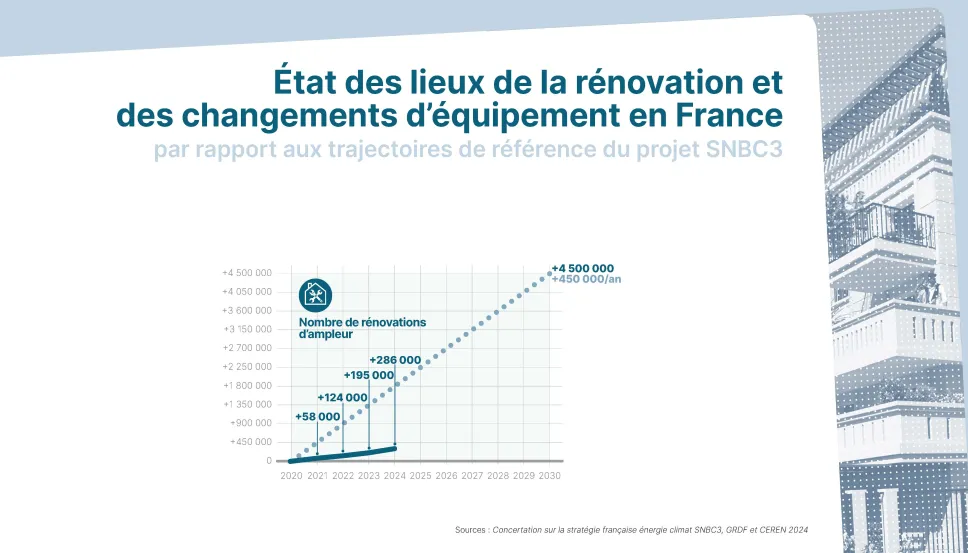
Given that the number of homes primarily heated by electric HPs was 3.2 million in 2024, with growth limited to +440,000 between 2023 and 2024 (source: CEREN), the target is ambitious. Especially since, to support the feasibility of its scenario and overcome the limitations of the electric grid—such as Peak Demand (see box)— RTE is counting on an acceleration of Energy Renovations, the development of Demand response measures, the construction of new capacity for Peak Demand, and the reinforcement of the power grids.
Furthermore, for reasons of cost and realism, these assumptions may be deemed difficult or even impossible to achieve from a social and industrial perspective.
At certain times of the year, energy demand spikes suddenly for varying lengths of time. This phenomenon occurs during the cold season, when temperatures drop sharply. The increased demand for heating adds to all other uses, pushing the power grid to its limits. This is known as the Winter Peak. And if demand exceeds available capacity, the balance is disrupted and everything stops—this is a “blackout.”
Moving from theory to practice therefore requires a number of fundamental conditions: the pace of renovations must be optimal, industrial capacity must keep up, the proposed solutions must be easily scalable, and the energy system must be able to adapt, all while keeping costs under control.
But what is the reality?

Credits: Getty Images
While precise data are not available for Commercial Buildings, it is possible to identify four categories of residential units currently heated by natural gas, each with its own characteristics.
These present few technical obstacles to switching to 100% electric Heat Pumps, even though existing radiators and electrical systems may sometimes need to be replaced, not to mention a possible need to upgrade local electrical grids.
Their environment imposes constraints regarding available outdoor space and proximity to neighbors for positioning the HP’s outdoor unit, as well as the Local Urban Planning Plan
(PLU) may restrict installation options, and interior volumes—which are often optimized in urban areas—limit the integration of Hot Water Tanks, which are essential for the operation of 100% electric Heat Pumps.
More than 70% of these are located in areas where connection to a district heating network is not possible. Furthermore, a study conducted by Pouget Consultants on behalf of the Directorate of Housing, Urban Planning, and Territories (DHUP) concludes that the installation of a 100% electric HP is feasible in only 50% of these buildings.
With very few exceptions, there is no efficient and widely applicable alternative to High Energy Performance Boilers (HEPB) for these buildings, due to structural, space, or regulatory constraints.
*Source: GRDF based on CEREN and INSEE
Actual statistics on large-scale renovations remain well below the targets set by European and French policies, whether for insulation work or for replacing equipment to phase out heating oil and coal, for example.
On the one hand, while the associated costs play a role, the instability of financial assistance programs—including reforms to MaPrimeRénov', changes to the Energy Efficiency Certificate (CEE), and eligibility requirements—makes the programs difficult to understand and slows down the start of renovation projects. Not to mention the rise in fraud in this area...
On the other hand, caught between installation targets set by policymakers and a market that is struggling to find the necessary momentum, HVAC manufacturers face a complex equation that complicates their own commitment and the mobilization of their production lines.
Credits: Patrick Guillon
Credits: Patrick Guillon
Credits: Patrick Guillon
As we have already seen, the role of natural gas in buildings for heat production is far from insignificant. Beyond the exorbitant costs associated with converting equipment in buildings, the widespread electrification of heating can only be achieved at the cost of colossal investments in existing electricity generation, transmission, and distribution infrastructure.
In light of the challenges identified, natural gas alternatives expand the range of solutions tailored to the sector’s specific needs, leveraging the Gas Network, which is becoming greener every day thanks to Biomethane—a renewable, low-carbon energy source derived from local regions.
Credits: Grégory Brandel
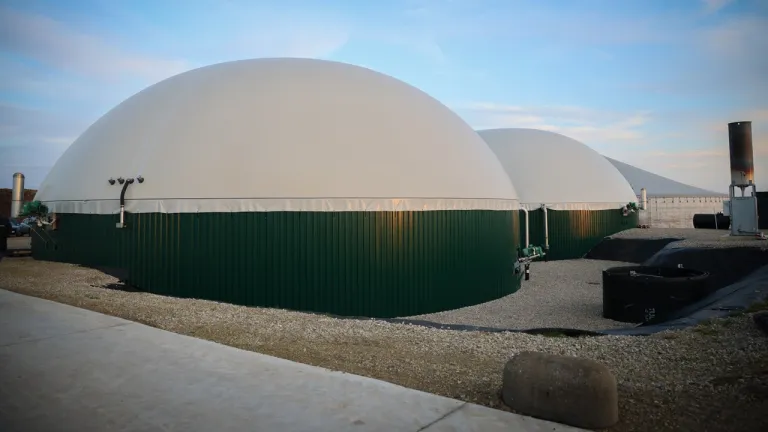
Produced through the recovery of organic waste from local communities, Biomethane is currently the most widely used green gas in France. By converting Livestock Effluents, agricultural residues, energy-from-agricultural-crops (CIVE), agrifood byproducts, household biowastes, and sewage sludge, Anaerobic Digestion is playing an increasingly important role in the energy landscape while helping to achieve Decarbonization of gas consumption.
To learn everything there is to know about Green Gas, visit our in-depth feature.
With an emission factor of 41.6 gCO2eq/kWh, Biomethane’s carbon footprint is nearly six times lower than that of Natural Gas. The gradual transition from fossil fuels to Renewable Gases should thus help reduce CO2 emissions associated with gas use by more than 80%. (source: ADEME Carbon Footprint Database)
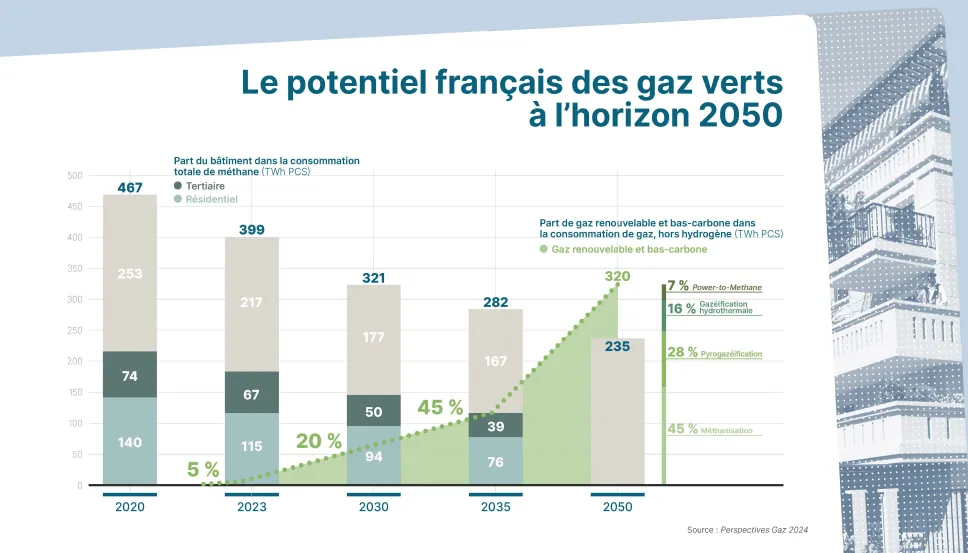
With the growing use of other Renewable Gases and low-carbon gases, the Green Gas Value Chain estimates that Green Gases will be able to cover 20% of all French consumption by 2030, more than 40% by 2035, and 100% by 2050, with a long-term production potential estimated at 320 TWh per year.
These projections are based on a downward trend in consumption and a demand of 321 TWh in 2030, 282 TWh in 2035, and 235 TWh in 2050 (compared to 350 TWh in 2025). (Sources: NaTran’s 2024 Gas Outlook and 2025 Gas Report)
Credits: Patrick Guillon
In the building sector, a downward trend has been evident for several years now. This is a direct result of energy conservation and Energy Efficiency measures that have helped control energy consumption through the adoption of eco-friendly practices, the deployment of more efficient equipment, and an increase in Energy Renovations.
The most economical and low-carbon energy is the energy we don’t use. The widespread adoption of Smart Gas Meters, the development of consumption-tracking tools, and the climate emergency have all contributed to raising awareness among building stakeholders, from users to managers. The implementation of targeted measures to limit energy waste is paying off and helping to reduce the sector’s Carbon Footprint. Gas heating is no exception.
A High Energy Performance Boiler is a condensing boiler that recovers Waste Heat from gas combustion—that is, the portion of heat produced but not utilized by the appliance. This technology makes it possible to extract even more energy from the same volume of gas consumed.
Replacing an old unit with a High Energy Performance Boiler results in 20 to 30% energy savings and an equivalent reduction in CO2 emissions. Immediately and wherever no other high-performance alternative is feasible.
The HEPB boiler is currently the most effective solution for significantly reducing a building’s Carbon Footprint at a lower cost.
However, THPE boilers account for only 55% of the existing boiler fleet, and their widespread adoption could prevent up to 3.5 million metric tons of CO₂ per year.
If we add the 2 million individual boilers in co-ownership buildings—whose replacement with an HEPB boiler depends on the renovation of shared flue systems*—this figure could even reach 4.5 million metric tons of CO2 avoided.
Even without government subsidies, the HEPB boiler remains a viable solution due to its ease of installation, efficiency, robust design, and manageable maintenance costs for households.
*Source: GRDF, based on MP data and data from the national registry of condominiums
By combining an electric heat pump with a High Energy Performance Boiler, the HHP brings together all the benefits of electricity and gas. Thanks to Smart Control, the system optimizes energy consumption based on current conditions, generally prioritizing the electric HP and switching to gas when temperatures drop or for domestic hot water production.
Suitable for both central and individual heating systems, the HHP not only generates energy savings but also delivers a dramatic reduction in CO2 emissions compared to a boiler alone: - 70% when replacing an older-generation unit, or even -90% if powered by Green Gas!
And because it combines two complementary units that are connectable to existing radiators, the HP and boiler can be sized precisely to meet needs, making them cheaper to purchase together than an electric HP alone and resulting in lower installation costs.
In its scenario, RTE projects that 2.5 million homes will be equipped with this system by 2050. ADEME even projects up to 5.7 million in one of its scenarios.
(source: RTE 2023–2035 Forecast Report and ADEME Transition(s) 2050)
In buildings with central heating, 1.4 million homes that are not easily compatible with 100% electric HPs could, however, benefit from an HHP—a viable solution to avoid widespread reliance on Joule-effect appliances, which place a heavy burden on energy consumption and the stability of the power grid.
(Source: Poujet Consultants Study – DHUP)
While the HHP represents one of the most effective combinations for decarbonizing buildings at a controlled cost and without placing too much strain on the power grid, other avenues are currently being explored. These rely on other renewable energy sources and incorporate gas as a backup.
For example, a High Energy Performance Boiler can be paired with a geothermal Heat Pump or a solar thermal system. In all cases, natural gas provides the necessary boost to take over when the main unit reaches its limits.
As part of a call for projects launched by the Union sociale pour l’habitat (USH), Coénove, the Association of Engineers and Technicians in HVAC and Refrigeration (AICVF), CEGIBAT, and GRDF—three industry partners—were selected to develop an HHP that could operate without an outdoor unit. The goal of the initiative was to develop a technical solution designed to overcome the challenges associated with installing the Heat Pump unit when space constraints, regulations, or proximity to neighbors make it impossible.
To learn more: Hide this outdoor unit so I can’t see it | Just Decarb
In France, the Gas Network helps support the electric grid when temperatures drop and electricity demand skyrockets. The widespread use of gas systems in buildings, combined with the generation capacity of gas-fired power plants, ensures that these occasional spikes can be handled with ease.
During these periods, the HHP can temporarily “engage demand response” on the power grid and switch entirely to the High Energy Performance Boiler until conditions return to normal.
By way of comparison, the electric grid has a mobilizable peak capacity of approximately 100 GW, whereas the gas network offers 160 GW. On February 8, 2012, a cold snap set a record of 102 GW in electricity demand and 158 GW in gas demand, preventing a “blackout.”
To learn more about gas during periods of extreme cold, click here.
Not only do gas solutions avoid adding to the costs of adapting the electric grid, but the transformation of gas networks to collect and distribute Green Gas has a much smaller impact than the transformation required for electric grids. In 2023, the Energy Regulatory Commission (CRE) estimated the budget needed to accommodate Green Gas between 6 and 9.7 billion euros by 2050. In total, the planned investments in gas networks are about seven times lower than those planned for the electric grids.
To take the decarbonization of buildings even further, billions of euros could thus be redirected toward energy-efficient, equitable, and sustainable renovations of energy-inefficient buildings for the community.
Let’s also not forget that, on a smaller scale, gas-based solutions such as HHPs offer savings on equipment and maintenance, freeing up additional financial resources for building improvements.
In practical terms, decarbonization means choosing the right energy source in the right place at the right time, drawing on available grids, the most efficient equipment, and local conditions.

Credits: Getty Images
With more than 50% of the building stock unable to be electrified, the building sector needs to rely on a diversified energy mix that incorporates all solutions that work and deliver concrete, immediate benefits. This helps meet climate goals, ensure a secure energy supply, and protect the purchasing power of households and communities.
Reducing the building sector’s Energy Transition to electrification alone ignores the constraints inherent in the diversity of buildings, Winter Peak, the seasonality of demand, and regional specificities. Choosing to preserve a true Energy Mix means choosing not to put all your eggs in one basket; the complementary nature of gas and electricity ensures resilience and minimizes the costs of upgrading grids.
Building on this pragmatic approach, Coénove conducted a study with the consulting firm Artelys and proposes alternatives to RTE’s baseline scenario. The main finding is that by relying more heavily on gas-based solutions and incorporating domestic hot water use into the calculations, it is not only possible to achieve the same level of Decarbonization as by relying solely on electric HP’s, but at a lower cost.
If, by 2030, 700,000 electric air-to-water HPs are replaced with HHPs in RTE’s baseline electrification scenario, the benefits are clear:
A scenario incorporating more High Energy Performance Boilers increases the savings even more significantly (€1.1 billion saved per year) without significantly worsening the environmental impact.
And with the share of Green Gas exceeding 20% instead of 10%, decarbonization is significantly greater than in RTE’s baseline scenario—which has been adjusted to account for the technical constraints of Heat Pump installation—at a virtually identical cost.
Promoting HHPs is essential, particularly when electric HP units face technical or economic installation constraints. Public incentive programs must take into account the realities on the ground.
Furthermore, the 20% share of Green Gas expected by 2030 represents a pragmatic, easy-to-implement solution that is industrially mature and consistent with the sector’s trajectories.
Stakeholders in the building sector, utility networks, and local governments are calling for a scaling up of Green Gas production and for these gases to be incorporated into French and European regulatory frameworks. The goal: to accelerate a just, technically realistic, and socially acceptable transition.
Traceability through Certificates of Origin (CoO) must therefore be integrated into the Energy Performance Certificate (DPE), the RE2020, and the transposition of the European Energy Performance of Buildings Directive (DPEB), in order to truly reflect the reduction in the Carbon Footprint of buildings powered by Biomethane.
Technical and economic constraints point to one conclusion: full electrification is neither technically feasible for the entire building stock nor economically optimal for the community.
Decarbonization of the building sector is a major challenge that requires a pragmatic and case-by-case approach. Maintaining gas as part of a balanced Energy Mix, combined with its gradual transition to cleaner sources, makes it possible to reconcile climate goals with the diverse realities on the ground.

Credits: Getty Images
It’s not the boiler that needs to be phased out, but the gas that needs to become greener.